

The United Nations Office at Geneva
Multimedia Newsroom
Lebanon: Increased violence along Blue Line and ‘horrific new normal’ for children
In southern Lebanon, peacekeepers have witnessed “shocking” destruction of villages along the Blue Line and ever-deeper Israeli ground incursions, while the situation of children across the country is becoming increasingly desperate, the UN said on Tuesday.
Andrea Tenenti, spokesperson for the UN Interim Force in Lebanon (UNIFIL), told reporters in Geneva that ground clashes inside Lebanon - some of them very close to UNIFIL positions - are becoming “more violent”.
While the Mission’s monitoring capabilities are limited because of the ongoing hostilities, it did see Israeli forces carry out incursions about “two or three kilometres deeper” inside Lebanese territory before withdrawing.
Speaking to reporters from Beirut, Mr. Tenenti said that daily Israeli airstrikes in Lebanon as well as missile and drone attacks by Hezbollah into Israel have caused “widespread destruction” of towns and villages on both sides of the Blue Line.
On the Lebanese side, the destruction “has been huge, shocking”. Villages like Kfar Kila, Maroun al-Ras and others “have been completely destroyed by the incursions of the IDF [Israel Defense Forces],” he said.
Out of an original population of some 600,000, Mr. Tenenti said that up to 60,000 people remain in UNIFIL’s area of operations in the south and need assistance. According to the UN International Organization for Migration (IOM), nearly 900,000 people are internally displaced in the country, close to 60 per cent of them from the south. As of Monday, more than 3,500 people have been killed and nearly 15,000 wounded since the start of the conflict on 8 October last year, as per Lebanon’s Ministry of Health.
UNIFIL itself has suffered “numerous hits on its assets and personnel” throughout the conflict but continues to facilitate life-saving humanitarian work in its area of operations, coordinating daily with the Israel Defense Forces (IDF), the Lebanese authorities and aid agencies, Mr. Tenenti said.
The Mission’s more than 10,000 peacekeepers from nearly 50 countries remain in their positions and “there is no discussion of withdrawing at all,” he insisted, despite the “very difficult conditions” faced by the peacekeepers close to the Blue Line.
“We are here not only because we need… to monitor and to be present and to do as much as we can to support humanitarian organizations, to assist the local populations, but also for the day after.”
“We are ready to support any agreement that can be decided by both sides,” he added.
The UNIFIL spokesperson further stressed that while Security Council resolution 1701, which forms the basis for the mission’s mandate, has been “significantly challenged” in the last 14 months, its key provisions of safety, security and long-term solutions “remain valid”, while its full implementation is still “one of the most viable political roadmaps to peace”.
UN Children’s Fund (UNICEF) spokesperson James Elder warned about the “silent normalization of horror” for the children of Lebanon, where three youngsters have been killed each day on average for the past two months, and “many more [are] injured, many more traumatized”.
“We must hope that humanity never again allows the ongoing level of carnage of children in Gaza, though there are chilling similarities for children in Lebanon,” he said.
These include the fact that hundreds of thousands have been forced to flee their homes amid Israeli airstrikes and that “disproportionate attacks” have hit the infrastructure that children rely on, notably medical facilities.
Mr. Elder also spoke of the “grave psychological impact” of the war on youngsters and deplored the lack of a “meaningful response” to the killing of children from “those with influence”.
Last weekend’s airstrikes in central Beirut have shown that, like in Gaza, “nowhere is safe” in Lebanon, the UNICEF spokesperson said.
“The frontline shifts everywhere. Families… are told to move. They don't know where to move to,” he said, emphasizing that for families who have lost their homes and are living in shelters, “that shelter does not represent any form of real safety to them”.
“Once more, the cries of children go unheard, the world’s silence grows deafening, and again we allow the unimaginable to become the landscape of childhood. A horrific and unacceptable new normal," Mr. Elder concluded.
Amid a continuing desperate humanitarian situation in the Gaza Strip, UN World Health Organization (WHO)’s spokesperson Margaret Harris raised the alarm about the conditions in Beit Lahiya’s embattled Kamal Adwan hospital.
The hospital’s 78 patients lack food, drinking water and medical supplies. “It's really only enough for two weeks at very best, but a lot of the specific supplies are just not there,” she warned.
The hospital is also short on medical staff, with only one paediatrician and one resident orthopaedic volunteer doctor. Four planned WHO missions to the hospital were denied by the Israeli authorities between 8 and 16 November while two other missions which were granted access, were not allowed to bring fuel, supplies or water.
“We urgently, urgently need to be able to bring in the correct aid to do the work to keep Kamal Adwan hospital functional,” Dr. Harris appealed. “And that means regular, unobstructed access, not arbitrary denials.”
“We need to be able to bring in the emergency medical teams. There are wonderful people who are willing to risk a very dangerous situation to help those children, but we're not being able to get them in,” she said.
-Ends-
STORY: Middle East update UNIFIL – UNICEF - WHO
TRT: 3:49”
SOURCE: UNTV CH
RESTRICTIONS: NONE
LANGUAGE: ENGLISH / NATS
ASPECT RATIO: 16:9
DATELINE: 19 NOVEMBER 2024 GENEVA, SWITZERLAND
1. Exterior wide shot: Palais des Nations, Flag Alley.
2. Wide lateral shot: Speakers at the podium of the press conference from rear; speaker on screens; journalists in the Press room.
3. SOUNDBITE (English) – Andrea Tenenti, spokesperson, UN Interim Force in Lebanon (UNIFIL): “We did see incursions enter deeper inside Lebanese territories, not sure how many kilometres but like two or three kilometres inside, but not permanently, so then they withdraw, they go back to their positions.”
4. Wide lateral shot: Speaker on screens; journalists in the Press room.
5. SOUNDBITE (English) – Andrea Tenenti, spokesperson, UN Interim Force in Lebanon (UNIFIL): “The destruction, nevertheless, has been huge, you know, shocking, what we see across the Blue Line, along the Blue Line, in villages like Kfar Kila, Maroun al-Ras and others, that have been completely destroyed by the incursions of IDF in these areas.”
6. Medium shot: Speakers at the podium of the press conference from rear; speaker on laptop screen.
7. SOUNDBITE (English) – Andrea Tenenti, spokesperson, UN Interim Force in Lebanon (UNIFIL): “There is no discussion of withdrawing at all. So, we are here not only because we need to be here to monitor and to be present and to do as much as we can to support humanitarian organizations, to assist the local populations, but also for the day after, to see what will be the role of the mission. We are ready to support any agreement that can be decided by both sides.”
8. Wide shot: Speaker on screens; journalists in the Press room.
9. SOUNDBITE (English) – Andrea Tenenti, spokesperson, UN Interim Force in Lebanon (UNIFIL): “Resolution 1701 has been significantly challenged in these 14 months, but its key provisions of safety, security and long-term solutions remain valid, while its full implementation still remains one of the most viable political roadmaps to peace.”
10. Medium shot: Speakers at the podium of the Press room.
11. SOUNDBITE (English) – James Elder, spokesperson, UN Children’s Fund (UNICEF): “Over the last two months in Lebanon, an average of three children have been killed every single day. Of course, many more have been injured, many more traumatized. Now, we must hope that humanity never again allows the ongoing level of carnage of children in Gaza. Though there are chilling similarities for children in Lebanon.”
12. Wide lateral shot: Speaker on screens; journalists in the Press room.
13. SOUNDBITE (English) – James Elder, spokesperson, UN Children’s Fund (UNICEF): “The frontline shifts everywhere. Families are moving, they're told to move. They don't know where to move to. So, it's important we sit on this phrase, ‘nowhere is safe’ for a moment and understand what that means to a family who's lost a home and is living in a shelter. But that shelter does not represent any form of real safety to them.”
14. Wide lateral shot: Speakers at the podium of the press conference from rear; speaker on screens; journalists in the Press room.
15. SOUNDBITE (English) – Margaret Harris, spokesperson, UN World Health Organization (WHO): “We are particularly concerned about Kamal Adwan hospital. There are still 78 patients there, including 58 adults. Of them, there are six in [the] intensive care unit, and there are 14 children in there. There's a lack of food and drinking water, shortage of medical supplies. It's really only enough for two weeks at the very best, but a lot of the specific supplies are just not there.”
16. Wide lateral shot: Speaker on screens; journalists in the Press room.
17. SOUNDBITE (English) – Margaret Harris, spokesperson, UN World Health Organization (WHO): “We urgently, urgently need to be able to bring in the correct aid to do the work to keep Kamal Adwan hospital functional. And that means regular, unobstructed access, not arbitrary denials.”
18. Medium shot: Journalists in the Press room.
19. SOUNDBITE (English) – Margaret Harris, spokesperson, UN World Health Organization (WHO): “It's impossible to plan, it's impossible to bring the things in, and we need to be able to bring in the emergency medical teams. There are wonderful people who are willing to risk a very dangerous situation to help those children, but we're not being able to get them in.”
20. Various shots of journalists in the Press room.
Similar Stories

1
1
1
Edited News | OHCHR , UNOG
UN Human Rights on Tuesday called on Egypt to end the persecution, harassment and intimidation of independent journalists and media outlets, and to respect press freedom.

1
1
2
Edited News | UNICEF
Drones and drought are "closing in" on Sudan, the UN Children's Fund, UNICEF, said on Tuesday, describing unprecedented attacks on the country's infrastructure including by drones travelling up to 1,500 kilometres before hitting their target.
"It is an assault unlike anything Sudan has seen before. In the last week of October, not a single day passed without a drone strike on a power station in Sudan. Up to 15 were hit in the month of October,” said agency spokesperson James Elder.
1
1
1
Edited News | IOM , UNHCR
Aid teams working to help millions of people uprooted by the ongoing war in Sudan appealed on Friday for more international assistance amid desperate funding shortages, empty warehouses and overwhelming needs.
1
1
1
Edited News | UNICEF
Ukraine has sustained almost 2,000 attacks on education since the full-scale Russian invasion in 2022, with some 270 this year alone, the UN Children’s Fund (UNICEF) said on Tuesday.
1
1
1
Edited News | UNHCR
More than 280,000 people have now been displaced by fighting in Yemen and many vulnerable people are unable to access lifesaving relief because it is too dangerous to do so, the UN refugee agency (UNHCR) said on Friday.
1
1
1
Edited News | UN
Tour guides at UN Geneva turned heads at the Palace of Nations on Thursday as they unveiled stylish new uniforms, designed in partnership with leading Italian sustainable fashion designers and manufacturers.
1
1
1
Edited News | OCHA , UNICEF , WFP
Aid agencies warned on Friday of the fast-developing humanitarian emergency inside Taiz City in Yemen, which has been encircled by de facto Houthi forces fighting government troops along the country’s west coast.
2
17
1
2
Edited News , Press Conferences , Images | OCHA , WMO
Two UN agencies teamed up on Wednesday to issue an appeal for immediate assistance to help communities already being impacted by the strongest El Niño on record.
3
16
2
2
Edited News , B-roll , Conferences , Images | UNITED NATIONS , UNOG
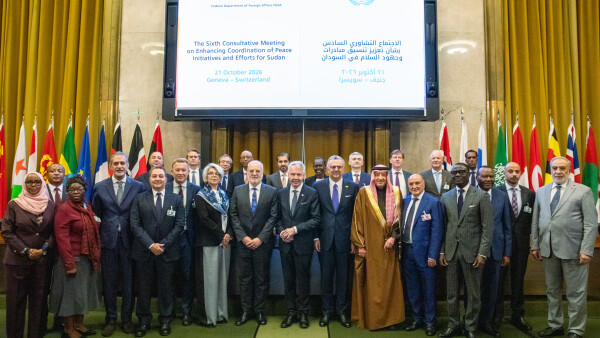
Sixth Consultative Meeting on Enhancing Coordination of Peace Initiatives and Efforts for Sudan
1
1
1
Edited News | UNICEF , WHO , UNHCR
Yemen war continues to force families from homes amid hunger and disease
More than 250,000 people have now fled renewed fighting in Yemen, the UN said on Tuesday, citing particular concern for those sheltering in the southwestern city of Taiz and the wider governorate, where access is “essentially blocked”.
1
1
1
Edited News | UNICEF
A little over one year since a ceasefire agreement was announced between Hamas fighters and Israel, more than 340 children have been reported killed and hundreds more injured, the UN Children’s Fund, UNICEF, said on Friday.
1
1
1
Edited News | UNICEF , IFRC
Six weeks after Nepal’s deadly flooding disaster, communities are still struggling to rebuild their lives, but they will need sustained help as global warming increases the risk of another Himalayan catastrophe, the UN Children’s Fund (UNICEF) said on Friday.