

The United Nations Office at Geneva
Multimedia Newsroom
The ozone hole over the Antarctic has reached its maximum annual size and is one of the largest and deepest in recent years, WMO warned.
The ozone hole over the Antarctic has reached its 2020 peak and is one of the largest holes of recent years, the World Meteorological Organisation announced today (6 October) at the United Nations in Geneva. The finding is based on observations by the European Union’s Copernicus Atmospheric Monitoring Service.
Speaking to the journalists, Clare Nullis, Spokesperson for the World Meteorological Organisation (WMO) said that the “European Union’s Copernicus Atmospheric Monitoring Service this morning issued a press release saying that the ozone hole over the Antarctic - which is an annual event – it’s one of the largest and one of the deepest in recent years”.
Each year in August, at the start of the Antarctic Spring, the ozone hole begins to grow and reaches its peak around October.
Ozone depletion over the Antarctic continent was first spotted in 1985. Over the last 35 years various measures have been introduced to reduce the hole such as the “Montreal Protocol on Substances that Deplete the Ozone Layer”, an international treaty designed to protect the ozone layer by phasing out the production of numerous substances that are responsible for ozone depletion. As a result of the international agreement, the ozone hole in Antarctica is slowly recovering.
Despite the growing hole, experts are confident that since the restrictions on ozone-destroying halocarbons was introduced via the Montreal Protocol, the hole has slowly been recovering. Climate projections indicate that the ozone layer will return to 1980 levels in 2060.
“The Montreal Protocol, which effectively phased out ozone-eating substances, is one of the most effective successful environmental treaties of all time. We cannot, however, be complacent”, warned WMO’s Clare Nullis.
Ozone depletion relies on extremely cold temperatures. Therefore, the colder the temperature in the stratosphere over Antarctica, the bigger the ozone hole.
“The air has been below minus 78 degrees Celsius and this is the temperature which you need to form stratospheric clouds and this quite complex process”, according to Clare Nullis. “But basically, the ice in these clouds triggers a reaction which then can destroy the ozone zone. So, it’s because of that that we are seeing the big ozone hole this year”.
Scientists are predicting that the ozone hole in spring will become smaller and recover as a seasonal event.
- Exterior wide shot, Palais des Nations flag alley, nations’ flags flying, a cloudy day.
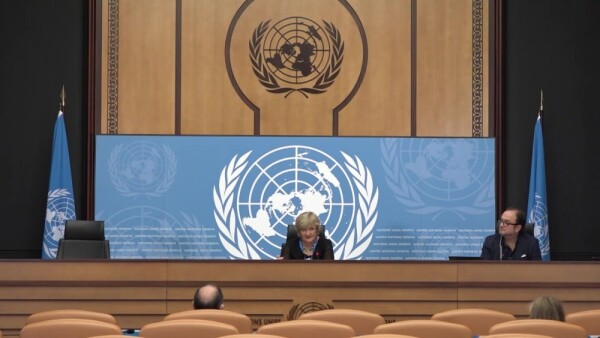
- Wide shot, podium with speakers in a near-empty Room XIV in line with COVID-19 distancing measures, side shot, Palais des Nations.
- SOUNDBITE (English) — Clare Nullis, Spokesperson for the World Meteorological Organisation (WMO): “European Union’s Copernicus Atmospheric Monitoring Service this morning issued a press release saying that the ozone hole over the Antarctic - which is an annual event – it’s one of the largest and one of the deepest in recent years”.
- Medium shot, journalist sitting with mask and laptop, Room XIV, Palais des Nations.
- SOUNDBITE (English) — Clare Nullis, Spokesperson for the World Meteorological Organisation (WMO): “The Montreal Protocol which effectively phased out ozone eating substances, it is one of the most effective successful environmental treaties of all time. We cannot, however, be complacent”.
- Medium shot, spokespeople in Room XIV, Palais des Nations.
- SOUNDBITE (English) — Clare Nullis, Spokesperson for the World Meteorological Organisation (WMO): “The air has been below minus 78 degrees Celsius and this is the temperature which you need to form stratospheric clouds and this quite complex process. But basically, the ice in these clouds triggers a reaction which then can destroy the ozone zone. So, it’s because of that that we are seeing the big ozone hole this year”.
- Medium shot, UN staff sitting and listening, Room XIV, Palais des Nations.
- Close up, hands writing
- Wide shot, podium
Similar Stories

1
1
1
Edited News | OHCHR , UNOG
UN Human Rights on Tuesday called on Egypt to end the persecution, harassment and intimidation of independent journalists and media outlets, and to respect press freedom.

1
1
2
Edited News | UNICEF
Drones and drought are "closing in" on Sudan, the UN Children's Fund, UNICEF, said on Tuesday, describing unprecedented attacks on the country's infrastructure including by drones travelling up to 1,500 kilometres before hitting their target.
"It is an assault unlike anything Sudan has seen before. In the last week of October, not a single day passed without a drone strike on a power station in Sudan. Up to 15 were hit in the month of October,” said agency spokesperson James Elder.
1
1
1
Edited News | IOM , UNHCR
Aid teams working to help millions of people uprooted by the ongoing war in Sudan appealed on Friday for more international assistance amid desperate funding shortages, empty warehouses and overwhelming needs.
1
1
1
Edited News | UNICEF
Ukraine has sustained almost 2,000 attacks on education since the full-scale Russian invasion in 2022, with some 270 this year alone, the UN Children’s Fund (UNICEF) said on Tuesday.
1
1
1
Edited News | UNHCR
More than 280,000 people have now been displaced by fighting in Yemen and many vulnerable people are unable to access lifesaving relief because it is too dangerous to do so, the UN refugee agency (UNHCR) said on Friday.
1
1
1
Edited News | UN
Tour guides at UN Geneva turned heads at the Palace of Nations on Thursday as they unveiled stylish new uniforms, designed in partnership with leading Italian sustainable fashion designers and manufacturers.
1
1
1
Edited News | OCHA , UNICEF , WFP
Aid agencies warned on Friday of the fast-developing humanitarian emergency inside Taiz City in Yemen, which has been encircled by de facto Houthi forces fighting government troops along the country’s west coast.
2
17
1
2
Edited News , Press Conferences , Images | OCHA , WMO
Two UN agencies teamed up on Wednesday to issue an appeal for immediate assistance to help communities already being impacted by the strongest El Niño on record.
3
16
2
2
Edited News , B-roll , Conferences , Images | UNITED NATIONS , UNOG
Sixth Consultative Meeting on Enhancing Coordination of Peace Initiatives and Efforts for Sudan
1
1
1
Edited News | UNICEF , WHO , UNHCR
Yemen war continues to force families from homes amid hunger and disease
More than 250,000 people have now fled renewed fighting in Yemen, the UN said on Tuesday, citing particular concern for those sheltering in the southwestern city of Taiz and the wider governorate, where access is “essentially blocked”.
1
1
1
Edited News | UNICEF
A little over one year since a ceasefire agreement was announced between Hamas fighters and Israel, more than 340 children have been reported killed and hundreds more injured, the UN Children’s Fund, UNICEF, said on Friday.
1
1
1
Edited News | UNICEF , IFRC
Six weeks after Nepal’s deadly flooding disaster, communities are still struggling to rebuild their lives, but they will need sustained help as global warming increases the risk of another Himalayan catastrophe, the UN Children’s Fund (UNICEF) said on Friday.